
‘Media freedom is not a marginal issue. It is a democratic imperative’: parliamentarians make the case in Strasbourg
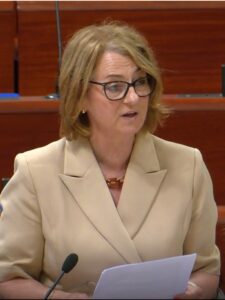
T.W. Trøen, Norway (EPP)

M. Gedvilas. Lithuania (SOC)

G. Psychogios, Greece (UEL)

B. Fresko-Rolf, Monaco (ALDE)

Y. Yasko, Ukraine (EPP)

M. Jensen, Denmark (SOC)

G. Stamatis, Greece (EPP)
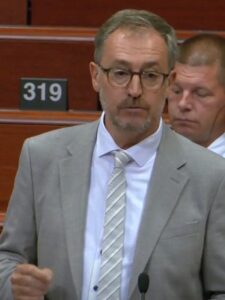
R.R. Buchel, Switzerland (ALDE)

A. Schoos, Luxembourg (ECPA)

K. Farnworth, United Kingdom (SOC)
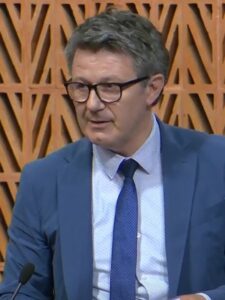
J. Vogt, Liechtenstein (ECPA)

A.S. Prammer, Austria (SOC)
“Media freedom is not a marginal issue. It is a democratic imperative. When critical journalism is perceived as a threat to political image rather than a contribution to public debate, press freedom is at severe risk.”.
That was how rapporteur Tone Wilhelmsen Trøen summed up the debate before the Parliamentary Assembly of the Council of Europe (PACE) voted unanimously on Thursday 25 June to back its report on media freedom in sport. As we reported, the report set out in detail the structural, political and commercial pressures now bearing down on independent reporting. But the debate that preceded the vote was where those pressures were given a human voice — and where speaker after speaker made the same point the rapporteur did: that what can look like a question about sport is, in the end, a question about democracy itself.
For the News Media Coalition, the debate mattered because it repeatedly returned to the ground where Primary Source Journalism lives: access to events and institutions, the terms attached to accreditation, the concentration of rights, and the protection of the people who do the reporting. Those themes surfaced again and again, across political groups and national delegations.
The rapporteur: ‘the space for independent sports journalism is shrinking’
Presenting her report, rapporteur Tone Wilhelmsen Trøen (Norway, EPP/CD) began by setting sport and journalism side by side. “At first sight, sport and independent journalism may seem like very different worlds. One is associated with passion, competition and entertainment, the other with scrutiny, investigation and accountability,” she told the Assembly. “But in reality, they are deeply connected.”
Her central warning was about defining the space. “The space for independent sports journalism is shrinking. Access to athletes, competitions and institutions is becoming more controlled. Accreditation systems are increasingly restricted,” she said. Journalists, she added, “are often required to sign agreements limiting the use of content or imposing conditions that would be unacceptable in other areas of public interest reporting.”
She was direct about why this happens. “The de facto monopoly status of many sports organisations reinforces a culture where criticism is not tolerated,” she said. “Too often, journalism is treated not as an essential democratic safeguard, but as a communication problem to be managed.” Pointing to the recent case of a whistleblower who exposed abuses linked to the Qatar World Cup and was prevented from travelling to Norway to speak at the Oslo Freedom Forum, she insisted that “attempts to silence whistleblowers and journalists must be condemned.”
Trøen closed on a line that framed the whole debate: “A healthy sports culture cannot exist without independent journalism. Transparency strengthens trust, accountability strengthens integrity, and freedom of expression strengthens democracy — also in sport.”
Replying at the end of the debate, she drew the threads together. “Media freedom is not a marginal issue. It is a democratic imperative,” she said. “When critical journalism is perceived as a threat to political image rather than a contribution to public debate, press freedom is at severe risk.” Her conclusion doubled as a summary of the room: “The unanimous message from this Assembly is that sports journalists must be free to hold those in power to account.”
The committee: ‘independent sports journalism cannot be taken for granted’
Recommending the report on behalf of the committee he chairs, Mogens Jensen (Denmark, SOC) placed the question in its wider setting. “Sport is much more than competition. It is a powerful social and cultural force with growing economic and political influence,” he said. “With that influence comes the need for transparency, accountability and independent scrutiny.”
Journalists, he argued, are what keep that scrutiny real. “Journalists play a vital role in ensuring that sport remains trustworthy. Their work is not limited to reporting results and achievements, but also includes asking difficult questions about governance, integrity and the use of resources.”
He ended with a name. “As we debate media freedom in sport, we should also remember the case of French sports journalist Christophe Gleizes, who remains detained in Algeria,” Jensen said. “His case reminds us that independent sports journalism cannot be taken for granted.”
Access, rights and the commercial squeeze
Continuing in Greek, Georgios Psychogios (Greece, UEL) made the case that reporting is a precondition of democratic sport, not an optional extra. “Free, independent and pluralistic journalistic coverage is not a luxury, but a fundamental precondition for democracy, transparency and accountability,” he said. Sports journalists, he added, “investigate, expose, scrutinise and bring to light corruption, manipulation, abuses of power and violations of human rights within sport.”
He was specific about what narrows their work. “The growing concentration of broadcasting rights in a few powerful economic actors, the commercialisation of sport, restrictions on access to events and contractual obligations create an environment that often limits independent reporting,” he said, warning too against “intimidation, strategic lawsuits — so-called SLAPPs — online attacks and threats that journalists face when they investigate sensitive issues in sport.” His conclusion was unambiguous: “Media freedom in sport is not a professional demand or a privilege. It concerns citizens’ right to know, the quality of our democracy and the credibility of sport. It is a matter of equality and the rule of law.” (Translated from the Greek.)
Georgios Stamatis (Greece, EPP/CD) brought the perspective of three decades in sport. “Sport is built on fair play, transparency and a set of rules. The same principles should apply to those who govern sport,” he said. Independent governance journalism, he argued, “helps uncover corruption, financial misconduct and other abuses that can undermine public trust” — but its value is not only defensive. “Media freedom in sport is not only about accountability, it is also about inspiration,” he said, pointing to the role of reporting in drawing young people towards sport in an increasingly sedentary age.
Béatrice Fresko-Rolfo (Monaco, ALDE), also speaking for her group, urged the Assembly to look past the fashionable term to the underlying problem. “There is a great deal of talk about ‘sportswashing’,” she said. “But let us not lose sight of the real issue … The real scandal — the one that deeply undermines the credibility of sport and the freedom of the media — is the existence of organised, documented and repeated systems of corruption.” (Translated from the French.)
Journalists in the firing line
Linsey Farnworth (United Kingdom, SOC) grounded the debate in the work of individual reporters. She recalled the late British investigative journalist Andrew Jennings, who exposed corruption in the International Olympic Committee and FIFA, quoting his own explanation of why he pursued it: “Sports organisations are in the public sphere. They’re backed by public money. They wield power. Why should they escape scrutiny?”
Britain, she said, “has been home to a number of highly skilled sports journalists who have uncovered major scandals after years of persistence and tenacity. We must support journalists to this end, which is why the establishment and continued work of the National Committee for the Safety of Journalists in the UK remains vital.” She then turned to a case from her own constituency — the investigative work of journalist Daniel Taylor into the circumstances surrounding the death of Sheffield United women’s footballer Maddy Cusack. Taylor’s work with the family, Farnworth said, “has led to a formal inquiry by the Football Association into her death,” with findings expected later this year.
Yelyzaveta Yasko (Ukraine, EPP/CD) connected media control to the wider health of democracy. “Sport has always been linked to politics since ancient Greek times, and those who report on sport have a direct influence on democracy,” she said. “Many authoritarian regimes use sport and sports federations, and they control the communication.”
She set out the toll of the war in stark terms: “In the last years in Ukraine, at least 800 sports facilities, including huge football arenas, were fully or partially destroyed. Almost 700 sportsmen have been killed. Many are serving in the army, and many sports journalists had to leave to work for the defence.” She asked colleagues to picture an athlete whose home arena — she named the Donbas Arena in Donetsk — is now under occupation and whose team can no longer play there. “When we talk about media freedom in sport, we should always remember where media control and democracy work together to ensure that we have freedom in our countries — which is then reflected in sport.”
Sport, independence and the limits of politics
Speakers approached the same principle from the athlete’s side.
Joachim Vogt (Liechtenstein, ECPA), a four-time Olympian, spoke from experience. “I had the privilege of taking part in the Olympic Games four times, so I can speak from my own experience. Sport is fair. Sport is focused. Political polarisation has no place there,” he said. “Sport is one of the few areas in which people from different countries and cultures meet as equals. It creates understanding where politics often fails.” His warning was against instrumentalising the contest itself: “Sport belongs to the athletes, not to a political agenda.” (Translated from the German.)
Martynas Gedvilas (Lithuania, SOC), who told the chamber he had “been involved in sport for more than 20 years,” made the case from inside the sporting world. “Sport is built on fair play, transparency and respect for rules. The same principles should apply to those who govern sport,” he said. “Independent sports journalism … helps uncover corruption, doping, financial misconduct and other abuses that can undermine public trust.”
Roland Rino Büchel (Switzerland, ALDE) made the case for journalism as the mechanism that keeps sport honest. “Many of the abuses of recent years — from corruption and the dismantling of FIFA’s rules to the manipulation of competitions — would never have come to light without courageous journalists,” he said. His argument for independence was blunt: “Free people deliver the best for the common good; so do free journalists. Sport does not need media financed by the taxpayer and dependent on politics — it needs free journalists.” (Translated from the German.)
Not every speaker endorsed every recommendation. Alexandra Schoos (Luxembourg, ECPA), speaking for her group, backed the fight against access restrictions but drew a firm line on how journalism should be supported. “The question today is not whether we want media freedom in sport. We all do,” she said. “The question is which means are appropriate and who should decide? This report, in parts, mistakes more regulation and more public funding for more freedom. We disagree. A press that depends on public subsidies is not an independent press. It is a state-managed press under a different name.”
A unanimous vote
The report was adopted without opposition. Across six political groups and a dozen national delegations, the debate converged on a single proposition: that access, accreditation and the terms attached to reporting are not administrative details but the conditions on which the public’s right to know depends — and that the people who do the reporting deserve protection, not management.
The News Media Coalition, whose assessment of 2026 FIFA World Cup rules is cited in the report itself, welcomes both the resolution and the breadth of support it drew in the chamber. As our first report on the vote set out, the substance now depends on implementation — on whether member states, sports bodies and event organisers translate these words into genuine, enforceable access for independent journalists, photographers and video teams.
Source: PACE — Committee denounces restrictions on media access in sport and growing control of content